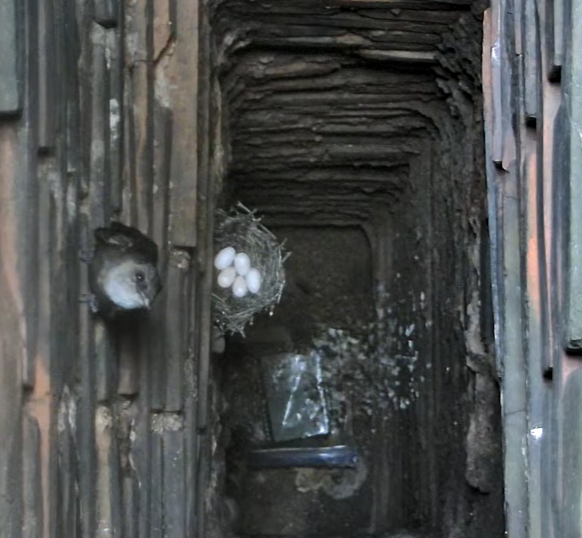
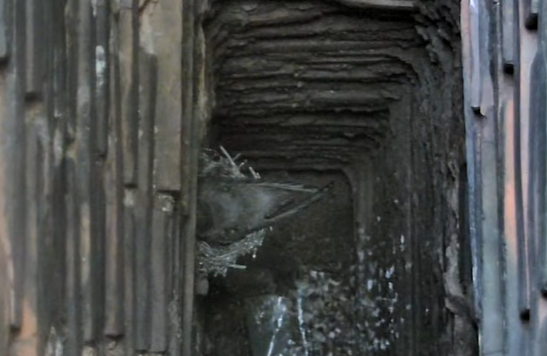
Follow a Chimney Swift pair as they build a nest, incubate eggs, and raise their young – thanks to the Michigan Audubon’s chimney camera!
Chimney Swifts: Masters of the Sky
The Chimney Swift (Chaetura pelagica) is one of North America’s most remarkable birds. Often described as a “flying cigar,” this small, gray bird spends most of its life in flight, catching insects, drinking, bathing, and even gathering nesting material while flying. Unlike most birds, Chimney Swifts cannot perch on branches. Instead, they cling to vertical surfaces such as chimneys. This unusual adaptation has shaped nearly every aspect of their lives – including their remarkable nesting strategy – and explains why chimneys have become such an important part of this bird’s survival.
The Chimney Swift is a focal species for the Joint Venture, representing the urban environment in the geography. Because this bird depends on towns and cities for nesting and roosting habitat, it serves as an important reminder that bird conservation extends beyond forests, wetlands, and grasslands to include the communities where people live and work.
Unfortunately, this aerial specialist is experiencing population decline. The 2025 State of the Birds report identifies Chimney Swifts as an Orange Alert Tipping Point species, meaning it has lost more than half its population during the past 50 years. One of the primary causes is the loss of suitable nesting and roosting habitat. Although Chimney Swifts likely benefited from the widespread construction of brick chimneys following European settlement, many traditional chimneys have since deteriorated, been capped, or replaced with modern designs that are unsuitable for nesting. As these structures disappear, so do important breeding opportunities for Chimney Swifts.
A Unique Nesting Strategy
Because Chimney Swifts cannot perch on tree branches like most birds, they have evolved a unique approach to nesting. Rather than building a nest among branches and leaves, Swifts gather small twigs while in flight, breaking them from tree branches with their feet and carrying them to a chimney or similar vertical structure. There, they use a glue-like saliva produced from a gland beneath the tongue to cement the twigs together and attach the nest directly to the chimney wall.
Although large numbers of swifts may roost together in a single chimney, only one pair typically nests in a chimney during the breeding season. Females usually lay 3–5 eggs, and both parents share incubation duties for approximately 16–21 days. Chicks grow quickly. Within about two weeks, they often outgrow the small nest platform and begin clinging directly to the chimney wall until they are ready to fledge. Eventually they will join the larger groups of swifts that are preparing for the migration to South America.
Watch a Chimney Swift Family in Real Time
This summer, Michigan Audubon launched a live camera inside a chimney at one of its preserves, offering a rare opportunity to observe the secretive nesting life of Chimney Swifts. A pair successfully nested in this same chimney in 2025. Activity resumed this year in early June, when a pair was observed carrying twigs into the chimney. Since then, they have completed their nest, laid five eggs, and are now taking turns incubating them. If all goes well, the eggs are expected to hatch by the end of July.
This live camera provides an extraordinary opportunity to observe behaviors that are normally hidden from view and offers viewers the chance to follow the nesting cycle from incubation, to hatch, and hopefully fledging!
We invite you to tune in and follow the journey of this remarkable pair of urban birds.
Sources:
Cornell Lab of Ornithology, All About Birds: Chimney Swift.
Upper Mississippi Great Lakes Joint Venture, Urban Bird Conservation Delivery Network