


Conservation Planning
Effective conservation planning is the foundation for successful bird habitat delivery. The Joint Venture begins conservation planning by stepping down population objectives from continental and national bird conservation plans to the JV region. These regional population objectives are then translated into measurable habitat objectives at state and local scales.
Focal Species
The individual JV bird-group strategies are the basis for habitat objectives. These strategies provide information to target bird habitat protection, restoration, and enhancement efforts in the UMGLJV geography. The common goal statement within each of the strategies is: “To establish efficient habitat conservation to maintain or increase carrying capacity for populations of priority bird species consistent with continental and JV regional goals.”
Strategic Habitat Conservation
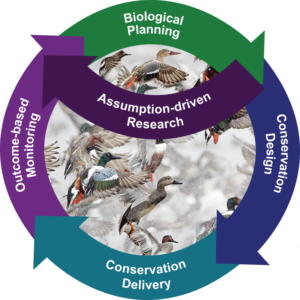
Joint Ventures use strategic habitat conservation (SHC), an adaptive, science-based approach to conservation, to consider the biological and ecological aspects of birds and their habitat requirements at multiple spatial scales, as well as the social science that is the foundation for the human dimensions aspect of conservation. Strategic habitat conservation is built on five main components:
- Biological Planning – working with partners to establish shared conservation targets and measurable biological objectives, and identifying limiting factors affecting our shared conservation targets;
- Conservation Design – creating tools that allow us to direct conservation actions to most effectively contribute to measurable biological outcomes,
- Conservation Delivery – working collaboratively with a broad range of partners to create and carry out conservation strategies with value at multiple spatial scales, and
- Outcome-based Monitoring – evaluating the effectiveness of conservation actions in reaching biological outcomes to then adapt future conservation planning and delivery and
- Assumption-driven Research – testing assumptions made during biological planning to refine future plans and actions. Both monitoring and research help us learn from our decisions and activities to improve them over time.