Migratory Bird Joint Ventures
Joint Ventures were established in 1986 to address the need for conservation of waterfowl and wetlands under the North American Waterfowl Management Plan. The Upper Mississippi Great Lakes Joint Venture (UMGLJV) was one of the original JVs to be created. Joint Ventures are a model of how regional partnerships with a demonstrated history of conserving habitat can benefit of birds, other wildlife, and people.
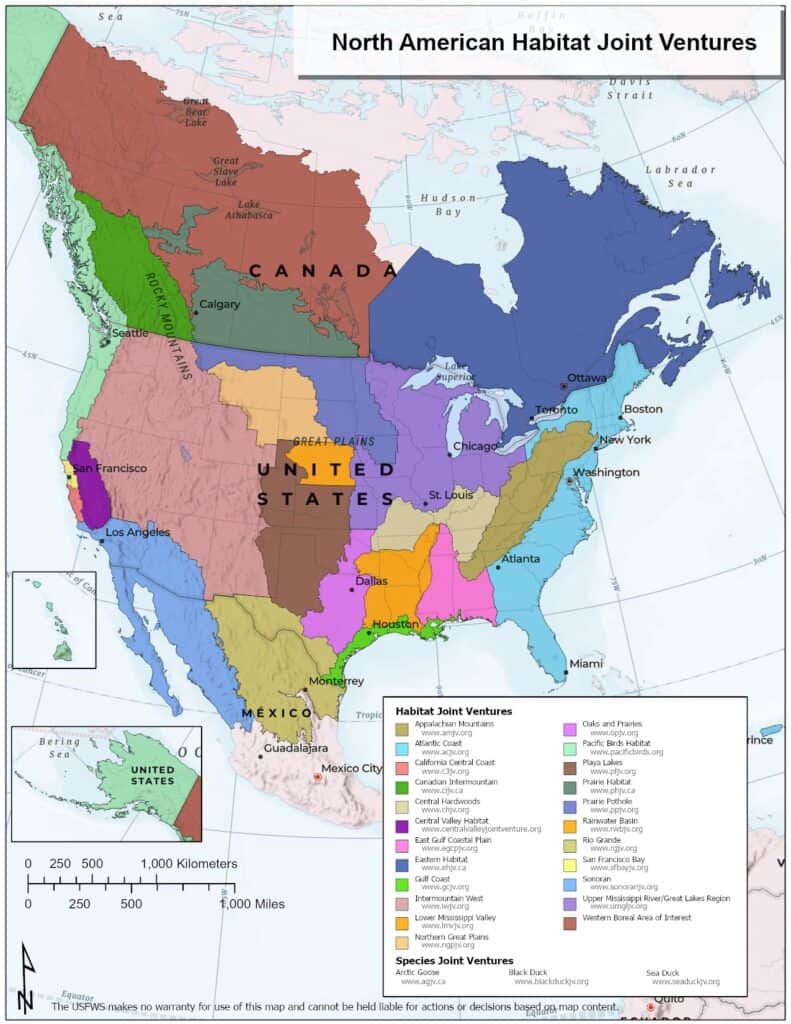
There are currently 23 Habitat Joint Ventures across the U.S., Canada and Mexico, including the UMGLJV. In addition, there are three Species-based Joint that are working to further the scientific understanding needed to manage populations of specific bird species (Arctic Goose, Black Duck and Sea Duck). Each JV is self-directed and represents a different geography, bird species, habitats, and communities, making each one unique. But all JVs share a vision of a North American landscape where native birds thrive, believing that the well-being of our nation depends upon the health of our landscapes and our wildlife.
Misson
To deliver the full spectrum of bird conservation through regionally based, biologically driven, landscape-oriented partnerships.
Who we are
The Upper Mississippi/Great Lakes Joint Venture (UMGLJV) is a self-directed non-regulatory private, state, and federal conservation partnership that works both collectively and independently to sustain bird populations and their habitats within the UMGLJV region. This is done by ensuring that continental objectives are met and that conservation actions are delivered efficiently and effectively at state or local scales.
What we do
The UMGLJV functions as the partnership in which the private, state, and federal conservation community develops a shared vision of bird conservation for the Upper Mississippi and Great Lakes regions; striving for conservation actions based in sound science; cooperates in its implementation; and collaborates in its refinement.